
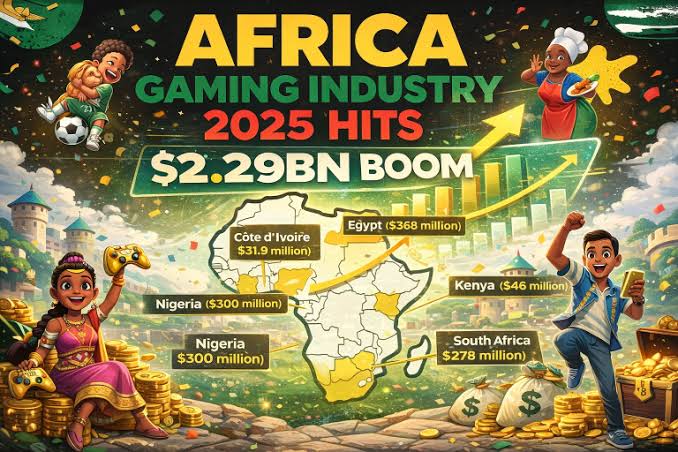
Africa’s video game market generated an estimated $2.29 billion in 2025, but the size of the market does not tell the full story of the continent’s gaming industry.
The figure, reported in the State of the African Video Game Industry 2026 by SpielFabrique, points to growing demand for games across the continent. Yet, the extent to which African developers and studios benefit from this spending remains a critical question.
The report estimates that the market is growing by an average of 12.32 per cent annually, with mobile games accounting for about 87 per cent of gaming activity. Smartphone adoption, a young population and wider access to digital services are helping expand the audience.
However, a large player base does not automatically translate into sustainable income for local developers. The industry still faces challenges around access to funding, payment infrastructure, distribution and the ability of studios to reach paying customers.
The market is also diverse. Egypt, Nigeria and South Africa are among its biggest contributors. The SpielFabrique report puts their 2025 gaming revenues at $368 million, $300 million and $278 million respectively, while Kenya generated about $46 million.
Across the continent, studios including Nigeria’s Maliyo Games and Ethiopia’s Qene Games are developing games for African audiences. Their presence points to a growing local production ecosystem, although the commercial performance of individual studios varies.
The gap between market growth and local earnings is particularly important because much of Africa’s gaming activity takes place on mobile devices. Mobile games are easier to access than console and high-end PC titles, but converting large audiences into paying customers remains difficult.
Payment limitations, low disposable incomes and the cost of data and devices can constrain spending. These barriers also affect how easily local studios can sell games, receive payments and expand beyond their home markets.
The global market offers a sense of the opportunity. Newzoo estimates that the worldwide games market will generate $213.9 billion in 2026. Mobile gaming is expected to account for $121.1 billion, followed by console games at $46.9 billion and PC games at $45.9 billion.
Africa remains a relatively small part of this global business, despite its expanding audience. A United Nations report, Level Up: Gaming and Violent Extremism in Africa, estimated that the continent had 349 million gamers in 2024, after adding 32 million players during the year. It valued Africa’s gaming market at $1.8 billion in 2024 and projected that it would exceed $2.5 billion by 2028.
The different estimates reflect different reporting periods and research methodologies, but both point to a market expanding faster than its existing infrastructure and local development capacity.
Africa’s gaming opportunity is not simply about attracting more players. It is about building the businesses, payment systems, publishing networks and distribution channels that allow local developers to earn from them. If the continent remains largely a market for games developed and published elsewhere, growth in player numbers may not translate into a proportionate expansion of African-owned businesses. The next measure of progress should therefore be not only how much Africans spend on games, but how much African studios earn, retain and reinvest.
Source archive dated 4 Nov 2026. This article is not a live update.
NextBigGames
Request a correction →