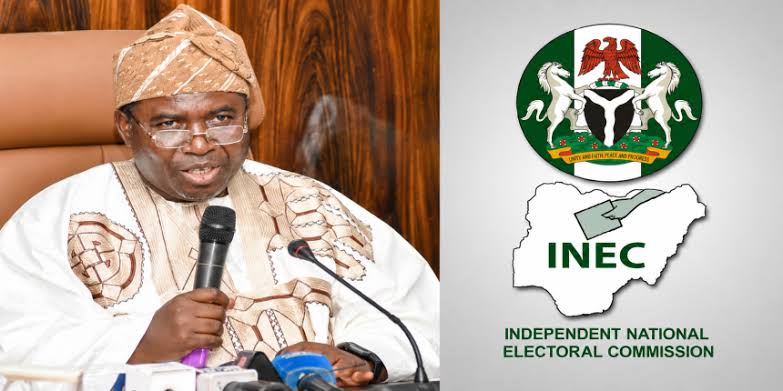
The Independent National Electoral Commission (INEC) has approved a comprehensive Artificial Intelligence (AI) Governance Framework, a significant step in its preparations for the 2027 general elections. But while the commission is moving to formalise how it uses AI, questions remain about the technology's implementation, oversight and potential influence on public confidence in the electoral process.
INEC Chairman Joash Amupitan announced the approval on November 9, 2026, saying the framework was developed in collaboration with the Institute for Security Studies (ISS) and the British High Commission. It was also peer-reviewed and revised with reference to the Economic Community of West African States (ECOWAS) framework on AI.
The approval marks a change from October 6, when Amupitan said the framework was still being finalised. However, as of November 11, the approved document had not been made publicly available on INEC's press-release page. That leaves voters, political parties, civil-society organisations and independent technology experts without an opportunity to examine its provisions.
The question is no longer simply whether INEC has rules for using AI. It is whether those rules provide enough transparency and accountability to make the technology trustworthy.
What INEC wants AI to do
INEC's proposed use of AI extends beyond administrative efficiency. The commission has discussed using automated systems to support the verification of election results, identify irregularities and strengthen the integrity of the voter register.
On October 22, INEC's Director of ICT, Dr Lawrence Bayode, explained that the commission was developing a system to examine polling-unit result sheets and compare figures entered electronically with information on scanned copies of Form EC8A.
The process is intended to help identify discrepancies before results are published on the INEC Result Viewing Portal (IReV). The commission has also indicated that the technology was piloted in Ekiti and Osun states. An important distinction is necessary here. The electronic system Bayode identified for data verification is the Data Verification and Authentication System (DIVAS), not the Bimodal Voter Accreditation System (BVAS). BVAS is primarily used for voter accreditation and related polling-unit processes. DIVAS is intended to support the verification of result data.
The distinction matters because the credibility of an election depends on several interconnected systems performing different functions. A tool that checks figures on a result sheet cannot, on its own, guarantee that the voting, counting, transmission and collation processes are accurate. INEC's Policy on Election Technology Acquisition and Deployment (PETAD), which took effect on September 25, 2025, already recognises AI as one of the technologies that may be deployed in the electoral process. The policy provides a framework for technology acquisition and deployment.
However, the existence of a general technology policy does not answer the practical questions surrounding the specific AI tools INEC intends to use. The public still needs details about how the systems work, what data they process, how discrepancies are flagged and what happens when their findings conflict with the physical result sheets.
The commission has not yet published detailed results from the Ekiti and Osun pilots that would allow independent observers to assess the systems' accuracy, limitations or effectiveness.
The voter register raises fresh questions
INEC's latest announcement also points to the growing role of automated systems in protecting the integrity of the voter register.
On November 9, Amupitan disclosed that the commission had harvested 11,088,238 registration records during the 2025/2026 Continuous Voter Registration exercise. Its Automated Biometric Identification System (ABIS) initially flagged 1,545,052 records for further examination.
Following screening and adjudication, INEC said 1,277,052 records were confirmed invalid and excluded before the preliminary register was published.
The commission subsequently reviewed another 268,000 cases following public complaints, claims and objections. Of these, 217,722 were found to be invalid, while 50,278 were retained. Further screening identified another 113,886 invalid registrations.
INEC reported that a total of 1,608,660 invalid registrations had been removed. It also said 873 records belonging to verified deceased persons were deleted, bringing its stated combined total to 1,609,553.
There is, however, a small discrepancy in the published figures: 1,608,660 plus 873 equals 1,609,533, not 1,609,553. The 20-record difference requires clarification from the commission.
INEC also said 54 personnel across 10 states had been identified as complicit in registration irregularities and could face disciplinary action, including prosecution. The figures demonstrate the scale of the register-cleaning exercise, but they also raise an important question about how automated systems should be used in decisions affecting citizens' voting rights.
It said ABIS did not automatically delete every record it flagged. Instead, the system identified records for further examination, with human adjudication determining which registrations were invalid.
That distinction is essential. Automated systems can identify patterns and possible duplication, but a flagged record is not, by itself, proof of wrongdoing. Human review, clear evidence and an opportunity to challenge decisions must remain central to the process.
The commission has also directed its ICT department to discontinue the use of web cameras for voter-registration photographs and move to an application-based camera system. The decision followed concerns that the previous web-registration process allowed photographs to be imported through external URLs, creating opportunities for manipulated or AI-generated images to enter the system.
Amupitan said INEC had traced access points and found that some access had been granted by authorised personnel. The commission has not yet published detailed technical specifications or a timeline for implementing the replacement system.
The changes suggest that INEC is responding to weaknesses in its digital infrastructure. But the public will need more than assurances that the system is being improved. It will need to understand how the new controls prevent abuse and how the commission will investigate irregularities.
Technology cannot replace electoral accountability
The need for transparency is particularly important given Nigeria's recent experience with election technology.
During the 2022 Osun governorship election, Yiaga Africa's observers reported that BVAS functioned in 80 per cent of the polling units they monitored, while technical problems were recorded in the remaining 20 per cent. The organisation also reported interruptions in the upload of 3,292 polling-unit results to IReV, with 471 still outstanding before uploads resumed.
These findings do not establish that results were manipulated. They do, however, demonstrate how technical failures can affect the availability of election information and deepen public uncertainty.
AI-assisted verification could help identify inconsistencies earlier, but it introduces another layer of questions. Who determines the thresholds for flagging discrepancies? Can political parties and accredited observers inspect the system's methodology? Are its decisions recorded in an auditable format? What happens when the system produces an incorrect alert or fails to detect an error?
These questions are not arguments against using AI. They are requirements for deploying it responsibly in an election where public trust is already fragile.
At the AI and Democracy Forum in Abuja, held from October 14 to 16, participants called for independent pre-election audits, transparent procurement and clear accountability for technology vendors. They also emphasised the need for published procedures covering Form EC8A capture, AI-assisted extraction, verification, collation and audit trails.
Microsoft separately committed to incorporating INEC's final candidate list into its systems to help restrict the generation of misleading synthetic images of candidates.
That concern highlights a second dimension of the AI challenge. INEC must consider not only how it uses AI internally, but also how political actors and other groups could use the technology to undermine the election.
Synthetic images, cloned voices, fabricated videos and misleading election-related content can spread rapidly, making it harder for voters to distinguish authentic information from manipulation. The commission's response will require coordination with technology platforms, clear public communication and credible mechanisms for verifying disputed content.
Amupitan has said that algorithms will not decide the 2027 votes. That principle must be reflected in the systems INEC deploys: technology should support electoral officials, not replace human responsibility or become an unchallengeable authority.
INEC's approval of an AI Governance Framework, its voter-register cleanup and its planned changes to registration technology show that the commission recognises the risks and opportunities associated with AI. But approval is only the beginning. The framework needs to be published, the result-verification pilots need to be independently assessed, and the commission must explain how automated decisions can be challenged and audited. For voters, the issue is not whether AI is sophisticated enough to process millions of records or compare figures on result sheets. It is whether the technology makes the election more transparent, accurate and accountable. Nigeria's 2027 elections will test not just the systems INEC has acquired, but the institution's willingness to subject those systems to public scrutiny. Technology may help protect the vote. Only transparency, independent oversight and accountable human decisions can make the public trust it.
Source archive dated 11 Nov 2026. This article is not a live update.
INEC
Request a correction →