
Nigeria’s care economy could generate between 9.4 million and 17 million jobs and contribute at least $9.3 billion to the country’s gross domestic product (GDP), offering a significant economic opportunity if the government can turn childcare and other essential care services into a properly funded, organised sector.
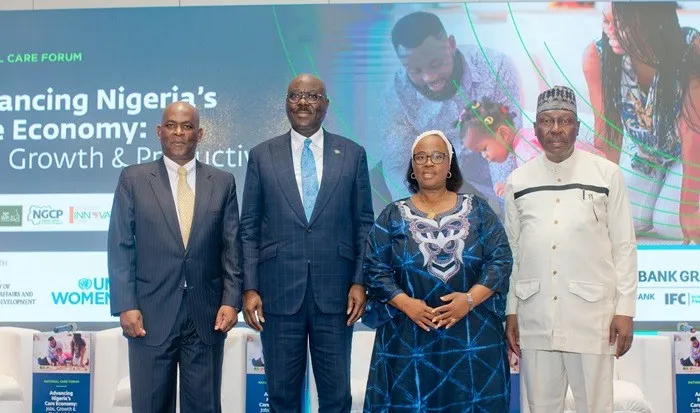
The projections were highlighted at the National Care Forum in Lagos on November 17, where government officials, development partners and private-sector representatives called for increased investment in childcare, elder care, disability support and other services that underpin household welfare and economic productivity.
Director of Child Development at the Federal Ministry of Women Affairs and Social Development, Andrew Ali Madugu, presented the figures on behalf of Minister Imaan Sulaiman-Ibrahim. He said the estimates reflected the economic potential of closing Nigeria’s care gaps and expanding access to universal childcare.
The projections are substantial, but they come with an important condition: Nigeria must invest in the infrastructure, services and workforce needed to make care more accessible. Without that investment, the economic benefits will remain largely theoretical.
The Federal Executive Council approved the National Care Policy and Implementation Plan 2026–2030 on October 28, marking an important step towards giving the sector a national policy framework.
The policy covers childcare, early childhood development, elder care, disability support, the welfare of care workers and family-friendly workplaces. It also proposes a National Care Fund to support implementation.
Madugu said the ministry was working with development partners, including UN Women, UNICEF, the World Bank and CARE Africa, to advance the policy. He urged state governments to adopt the framework and translate its provisions into policies and programmes that reflect local needs.
The childcare gap is an economic problem
For millions of Nigerian households, the shortage of affordable and reliable childcare is more than a family inconvenience. It is a constraint on employment, business growth and household income.
Women continue to shoulder a disproportionate share of unpaid care responsibilities, often forcing them to make difficult choices between earning an income and looking after children or other family members.
A senior economist at the World Bank Group’s Gender Innovation Lab, Ayodele Fashogbon, presented findings showing that Nigerian women spend an average of 76 minutes daily on childcare, compared with 13 minutes for men. He also estimated that about 33 million children aged zero to five lack access to centre-based childcare.
The employment consequences are significant. According to Fashogbon, women's employment declines by approximately 36% following the arrival of a child below the age of six, while men's employment increases by about 10%.
Expanding access to quality childcare could help reverse some of that imbalance. Fashogbon said better childcare provision could increase women's employment by 8.5%, raise their incomes by 22.5% and lift household incomes by approximately 44%.
The broader economic opportunity extends beyond childcare. When parents, particularly women, have access to dependable care services, they have more time to participate in paid employment, develop businesses and pursue opportunities that might otherwise remain out of reach.
World Bank Group officials also highlighted the potential gains from narrowing Nigeria's gender gap in labour-force participation, estimating that doing so could add as much as $22.9 billion to annual GDP.
Finance remains a major obstacle
Despite the economic potential, Nigeria's childcare market remains fragmented, dominated by small operators and constrained by limited access to capital.
Fashogbon said approximately 75% of childcare providers struggle to secure financing, while only 5% of private-sector employers invest in childcare services.
Head of Office of the International Finance Corporation (IFC) in Nigeria, Christian Mulamula, said about 92% of childcare facilities were small, independently owned businesses, while 76% of childcare entrepreneurs lacked access to formal finance.
These constraints affect both the supply and affordability of care. Small providers often lack the capital to expand, improve facilities or meet professional standards, while families face limited access to services they can reliably afford.
The IFC and World Bank are therefore seeking to make childcare more attractive to financial institutions and investors, while supporting women-led businesses to become investment-ready.
Mulamula also highlighted progress under the World Bank-supported Innovation Development and Effectiveness in the Acquisition of Skills (IDEAS) Project, which supported the development of Nigeria's first National Occupational Standards for Childcare.
More than 4,500 aspiring caregivers and entrepreneurs, approximately 90% of them women, are undergoing training towards the standards. The initiative is intended to professionalise childcare services, improve service quality and create more opportunities for women to build businesses in the sector.
Lagos looks to attract private investment
At the forum, the Lagos State Commissioner for Finance, Abayomi Oluyomi, representing Governor Babajide Sanwo-Olu, said the state was developing a care policy framework designed to attract private investment and improve access to quality services.
He said Lagos intended to establish appropriate regulations and safety standards while working with financial institutions to develop financing models for childcare businesses.
Oluyomi also urged employers to recognise childcare as a productivity investment rather than simply an additional operating expense, arguing that workplace childcare support could improve employee retention and performance.
The state's approach reflects a wider challenge for Nigeria: federal policy approval alone cannot build a functioning care economy. State governments must translate national commitments into practical regulations, funding arrangements and service-delivery systems.
Nigeria's care economy presents an opportunity to address two economic problems simultaneously: the shortage of decent jobs and the barriers preventing millions of women from participating fully in the workforce. But the headline projections should not be mistaken for guaranteed outcomes. The $9.3 billion GDP opportunity and the estimated 9.4 million to 17 million jobs depend on different modelling assumptions and substantial investment in care services. The job scenarios, in particular, imply significant public spending. The National Care Policy provides a starting point, but its success will depend on what follows: a funded National Care Fund, state-level implementation, affordable childcare, accessible financing for providers and enforceable standards that protect both children and care workers. For investors, the opportunity is to help build a market that is currently underserved. For government, the challenge is to ensure that commercial investment does not come at the expense of affordability and quality. Ultimately, Nigeria cannot build a more productive economy while leaving the responsibility of sustaining its workforce largely on unpaid labour within households. Recognising care as economic infrastructure is the first step. Financing and delivering it at scale will determine whether the projected opportunity becomes a reality.
Nairametrics
Request a correction