
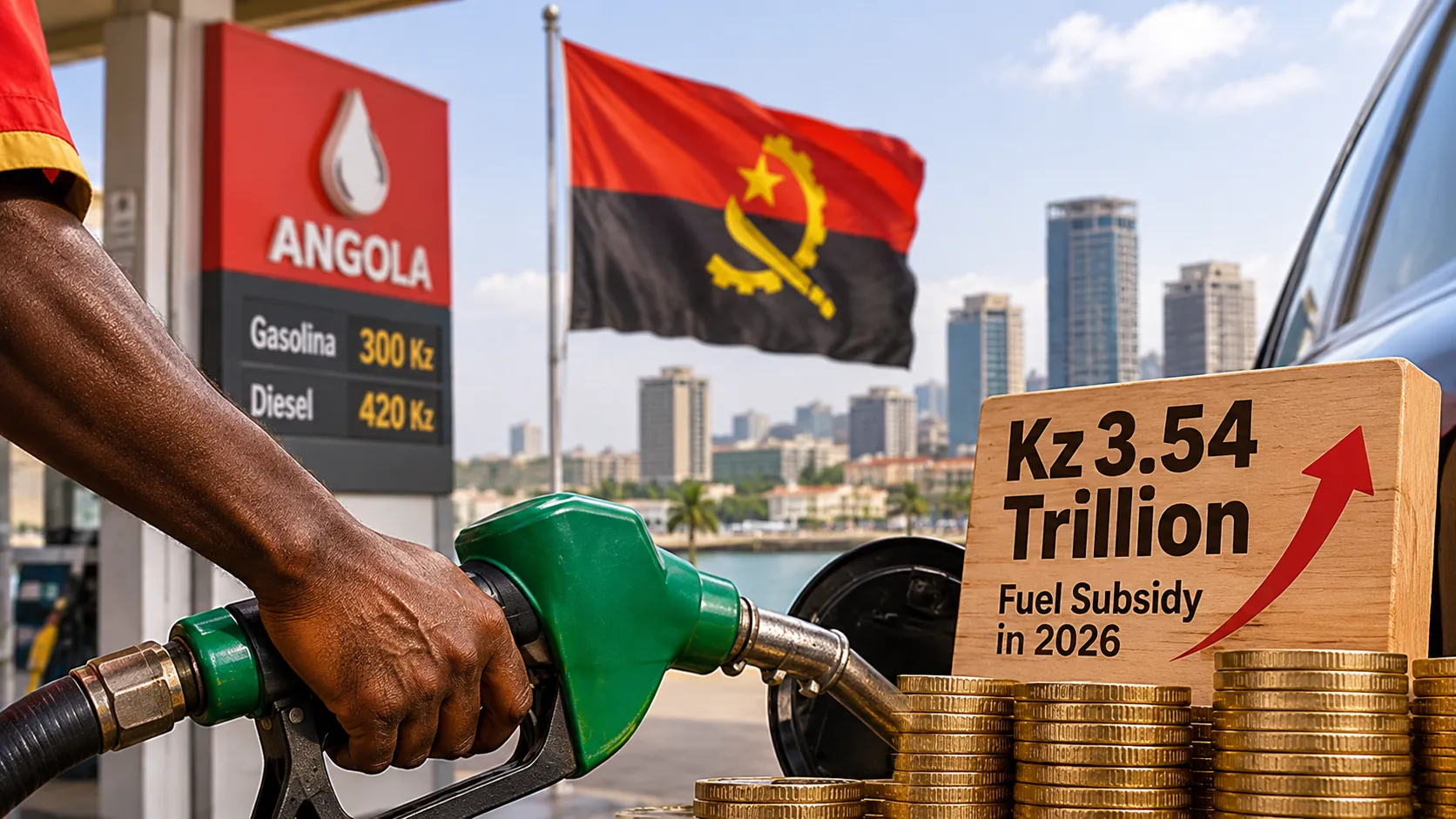
Angola's effort to make fuel more affordable is becoming an increasingly expensive commitment for its government. Despite years of gradual subsidy reductions, the oil-producing country now expects to spend approximately $3.9 billion on fuel subsidies in 2026, equivalent to 3.54 trillion kwanzas at the official exchange rate as higher international energy prices push up the cost of supplying petrol and diesel to domestic consumers.
Following the upward revision of 2026 fuel subsidy spending to Kz3.54 trillion, the government's proposed 2027 budget cuts total subsidy allocations by more than half to Kz1.52 trillion ($1.66 billion). It also means subsidy spending could account for approximately 2.35% of the country's gross domestic product (GDP).
The revised estimate follows an earlier warning in October from Ottoniel dos Santos, Angola's Secretary of State for Finance and the Treasury, who told Reuters that subsidy expenditure could reach between 3.7 trillion and 3.8 trillion kwanzas, equivalent to approximately $4.16 billion.
The government's subsequent budget assessment places the projected cost somewhat lower, but the underlying problem remains unchanged: Angola is spending considerably more than planned to prevent international fuel-price movements from being passed directly on to consumers.
The pressure exposes a longstanding weakness in the country's energy economy. Angola exports crude oil but imports most of the refined petroleum products it consumes, leaving its domestic fuel market vulnerable to international supply disruptions and rising import costs.
Why Angola's subsidy bill keeps rising
Angola's exposure to international fuel prices reflects an unusual imbalance in its petroleum industry. Although the country is one of Africa's significant crude oil producers, it has historically lacked sufficient domestic refining capacity to meet its fuel requirements. Consequently, it exports crude oil while purchasing substantial quantities of refined petrol and diesel from international suppliers.
According to the government's 2027 budget report, Angola imports most of its refined fuel requirements. This means that increases in international fuel prices translate into higher procurement costs, even when the country benefits from stronger crude oil export earnings.
The situation became particularly difficult in 2026 following the escalation of conflict in the Middle East and the disruption of shipping through the Strait of Hormuz, an important route for global energy supplies.
Domestic retail pump prices have remained administratively capped at 300 kwanzas per litre (about $0.33) for petrol and 420 kwanzas per litre (about $0.46) for diesel. While petrol has held steady at Kz300 since June 2023, the government raised the standard diesel tariff by 5%—from Kz400 to Kz420—in June 2026, leaving Angola with the second-lowest petrol prices and fourth-lowest diesel prices in Africa.
The government therefore absorbed much of the difference between the cost of acquiring fuel and the prices consumers paid at the pump. The consequences were already visible in the first half of the year. Subsidy expenditure reached 1.73 trillion kwanzas by June, exceeding the entire original annual allocation of 1.18 trillion kwanzas.
The Finance Ministry estimates that the additional 2.36 trillion kwanzas required for subsidies will be a major contributor to the deterioration of the country's non-oil primary fiscal deficit, projected at 9.01% of GDP, above the statutory target of 5%.
The cost of protecting consumers
Fuel subsidies are politically sensitive because their effects extend well beyond the petrol station. In Angola, transport costs influence the prices of food, household necessities and other goods. Keeping fuel prices relatively low therefore provides some protection against inflation, particularly for households whose incomes cannot easily absorb additional expenses.
But maintaining that protection requires substantial public spending. The problem is that broad fuel subsidies are not necessarily the most efficient way to support vulnerable households. People and businesses that consume more fuel generally receive a larger share of the benefit, regardless of their income.
An International Monetary Fund (IMF) assessment of Angola's subsidy system found that, in the earlier years of the programme, the wealthiest 20% of households consumed roughly two-thirds of subsidised fuel, receiving substantially more support than the poorest households.
This creates an important distinction between making fuel cheaper for everyone and providing meaningful financial protection to people who need it most.
The money committed to maintaining artificially low fuel prices could otherwise support infrastructure, healthcare, education and targeted social protection. The government's challenge is therefore not simply reducing expenditure but ensuring that any savings translate into better economic and social outcomes.
Angola's subsidy reforms have not solved the problem
Angola began a phased fuel subsidy reform programme in 2023, recognising that maintaining fuel prices substantially below market levels was becoming fiscally unsustainable.
The first major adjustment came in June 2023, when the government increased petrol prices from 160 to 300 kwanzas per litre, an increase of approximately 87.5%.
Diesel prices were subsequently adjusted through several increases between April 2024 and June 2026, eventually rising from 135 to 420 kwanzas per litre.
These changes helped reduce the subsidy burden. According to the government's figures, expenditure declined from 2.65 trillion kwanzas in 2024 to 2.14 trillion kwanzas in 2025.
However, the gains have proved vulnerable to external shocks. The 2026 experience demonstrates that even after several rounds of price adjustments, the government remains exposed to international fuel costs as long as domestic prices are controlled and imports account for most refined fuel supplies.
The IMF has similarly identified subsidy reform as an important part of Angola's broader fiscal consolidation programme, while highlighting the need for measures to protect households affected by higher energy prices.
The bigger challenge is reducing dependence on imported fuel
For Angola, reducing the subsidy bill will require more than adjusting prices at the pump. It will also depend on whether the country can strengthen its domestic refining industry and reduce its exposure to imported petroleum products.
Expanding domestic refining capacity could help retain more value from Angola's crude oil production, reduce dependence on international suppliers and improve the country's ability to manage domestic fuel supply.
However, building refineries is capital-intensive, and additional refining capacity will not automatically eliminate exposure to global oil prices. The commercial viability of local refineries, access to reliable crude supplies, operational efficiency and distribution infrastructure will all matter.
The government must also address the social consequences of further price adjustments. A more sustainable approach would combine gradual subsidy reductions with targeted cash transfers, transport assistance and other forms of social protection for vulnerable households. Such measures could help protect purchasing power without requiring the government to subsidise every litre of fuel consumed.
But targeted support requires reliable beneficiary data, effective payment systems and the administrative capacity to reach households that need assistance. Without these safeguards, subsidy reform risks increasing living costs before alternative protection mechanisms become effective.
Angola's experience also illustrates why economic diversification remains central to its fiscal strategy. Oil revenue provides an important source of government income, but it cannot reliably finance a growing economy when production constraints, international price movements and domestic energy costs create competing demands on public finances.
The government's 2027 budget report acknowledges this structural problem. Higher oil prices can increase export earnings while simultaneously raising the cost of imported refined products. In 2026, the government estimates that the additional subsidy burden absorbed approximately half of the increase in projected petroleum revenue compared with the original budget.
That is a significant reminder that stronger oil prices do not necessarily translate into equivalent improvements in government finances.
Angola's fuel subsidy crisis exposes the limitations of an economy that exports crude oil but depends heavily on imported refined petroleum products. The projected 3.54 trillion kwanzas in subsidy spending could otherwise support infrastructure, public services and economic diversification. However, removing subsidies without adequate protection risks increasing the financial burden on households and businesses. Angola's challenge is to turn subsidy reform into broader energy-sector restructuring through domestic refining, more efficient public spending and targeted social protection. Until these changes take hold, the country will remain caught between the cost of keeping fuel cheap and the consequences of making it more expensive.
Graphical Illustration
Request a correction