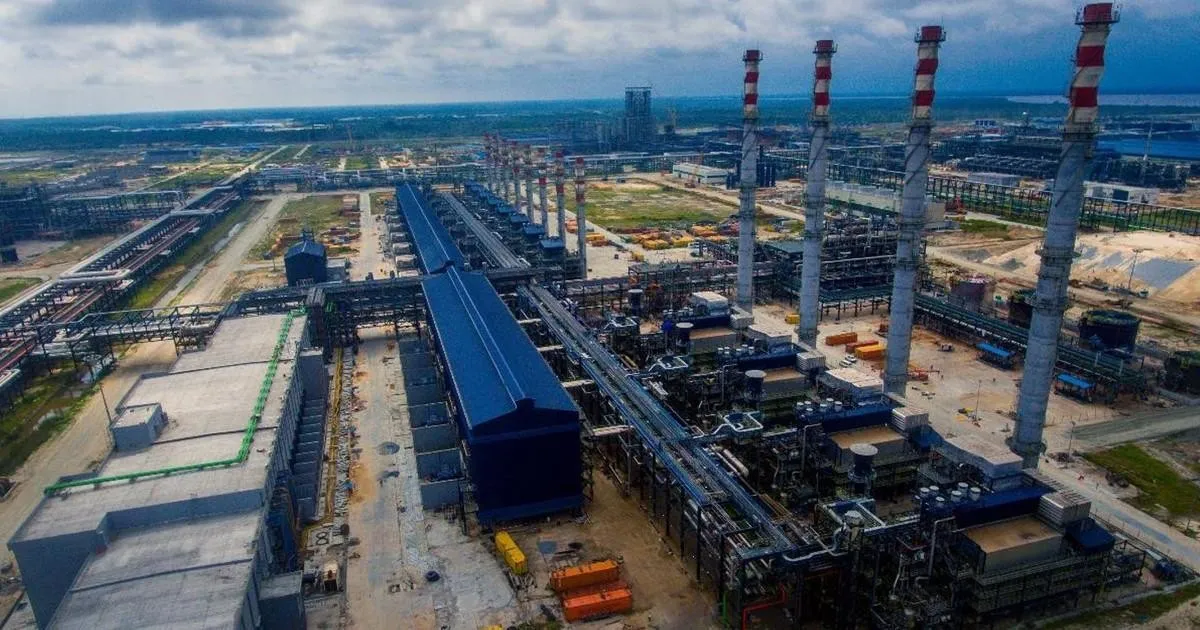
Almost 3.8 million investors applied for shares in Aliko Dangote's refinery, making its initial public offering (IPO) one of the most significant exercises in public participation in Nigeria's capital market. But beneath the impressive subscriber numbers is a less obvious reality: ordinary investors accounted for most of the applications while seeking only a tiny proportion of the shares.
Data from the allotment schedule show that 3,189,232 applicants, representing approximately 84.39% of the 3,779,362 subscribers, applied for between 10 and 100 shares each. Together, they requested 62.26 million shares worth ₦32.69 billion at the offer price of ₦525 per share.
That represents just 0.56% of the 11.15 billion shares investors applied for, valued at approximately ₦5.85 trillion.
The distinction matters. Although ordinary investors dominated the IPO by number of participants, their combined demand represented only about 1.52% of the 4.1 billion shares initially offered.
By Afrikons' calculation, each applicant in this smallest subscription category requested an average of approximately 19.5 shares, worth about ₦10,200. The minimum subscription was 10 shares, costing ₦5,250.
At the other end of the market, a relatively small number of large investors accounted for a substantial proportion of demand. The concentration was particularly pronounced among institutional and high-net-worth applicants, including three investors whose individual applications reportedly fell between one billion and five billion shares.
The figures reveal an important distinction in Dangote's ambition to make the refinery's ownership accessible to ordinary Nigerians: getting millions of people through the door is not necessarily the same as distributing ownership widely.
SEC clears the way after weeks of uncertainty
The Securities and Exchange Commission (SEC) approved the refinery's basis of allotment on Monday, November 23, clearing a major regulatory hurdle after the offer closed on October 27.
The basis of allotment determines how available shares are distributed when applications exceed the number offered. Its approval allows the company and its registrars to proceed with the allocation process, refunds and preparations for listing on the Nigerian Exchange (NGX).
The delay attracted attention partly because of concerns about whether ordinary Nigerian investors would receive adequate protection in an offer that drew demand from major domestic and international investors.
In May, the Independent Shareholders Association of Nigeria (ISAN) had called on the refinery, the SEC and the NGX to reserve a defined portion of the offering for domestic retail and minority shareholders. The association argued that without such protection, institutional investors could dominate an opportunity being presented as a chance for ordinary Nigerians to participate in a major national industrial asset.
The eventual allotment structure appears to have addressed much of that concern.
Why the biggest investors will absorb the cuts
The refinery initially offered 4.1 billion shares at ₦525 each, targeting approximately ₦2.15 trillion. However, applications reached 11.15 billion shares, equivalent to demand of about 2.72 times the original offer.
To accommodate more investors, the company pursued an increase of up to 30% in the offer size. The allotment schedule provides for approximately 5.196 billion shares, valued at ₦2.73 trillion. This represents an increase of about 26.7% over the original offer.
Under the approved distribution structure, applicants who requested between 10 shares and 10 million shares are expected to receive their full applications. The reductions will affect 41 investors who applied for more than 10 million shares each.
This means the smallest investors will not be competing directly with the largest applicants for a proportionate share of the original offer. Instead, the expanded issuance allows the company to accommodate more demand while concentrating the reductions among the biggest orders.
However, receiving every share requested does not mean retail investors will own a substantial portion of the refinery.
The original offer also included an option to increase the number of shares by up to 30%, giving the refinery room to respond to the unusually strong demand. The 5.196 billion shares in the allotment schedule represent most of that additional capacity.
The structure is significant because it protects smaller applicants from being crowded out by investors with the financial capacity to submit much larger orders. It also means the largest institutional and high-net-worth applicants will bear most of the reductions.
From allotment to the stock market
With regulatory approval secured, attention has shifted to when investors will receive their shares and when trading will begin. In an important development on Wednesday, November 25, Dangote Group Vice President for Oil and Gas, Devakumar Edwin, told Reuters that the refinery's shares are scheduled to begin trading on the Nigerian Exchange on December 1. This provides a clearer timetable than earlier reports, which had pointed to a December listing without a confirmed date.
Under the offer's prospectus, successful investors' shares are expected to be credited to their accounts with the Central Securities Clearing System (CSCS) within 15 business days of allotment. Applicants who receive fewer shares than requested, or whose applications are rejected, are entitled to refunds of the unallotted money within five business days of the allotment date.
Investors should also distinguish between payment confirmation and successful allotment. The refinery's official IPO portal makes clear that evidence of an application or payment does not establish how many shares an investor will ultimately receive.
Once listed, the refinery will enter a different phase of public scrutiny. Its share price will be exposed to market sentiment, investor expectations, financial performance and the company's ability to sustain its operations and expansion plans.
The listing will also provide the Nigerian capital market with an opportunity to value one of the continent's most ambitious industrial investments through public trading.
Dangote Refinery IPO is testing whether public participation in major African infrastructure projects can translate into meaningful ownership. Although nearly 3.8 million people applied, small investors accounted for just 1.52% of the refinery's original share offer. Their participation is significant, but the figures expose the gap between attracting millions of shareholders and distributing ownership widely. As trading approaches, attention will shift to the refinery's financial performance, transparency and ability to deliver sustainable returns. Ultimately, the success of the people's IPO will depend not on how many Nigerians applied, but on the value their investment delivers.
Dangote Refinery
Request a correction